
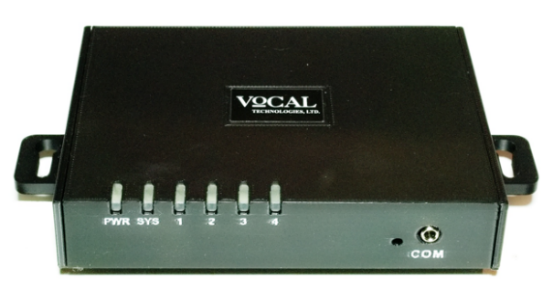
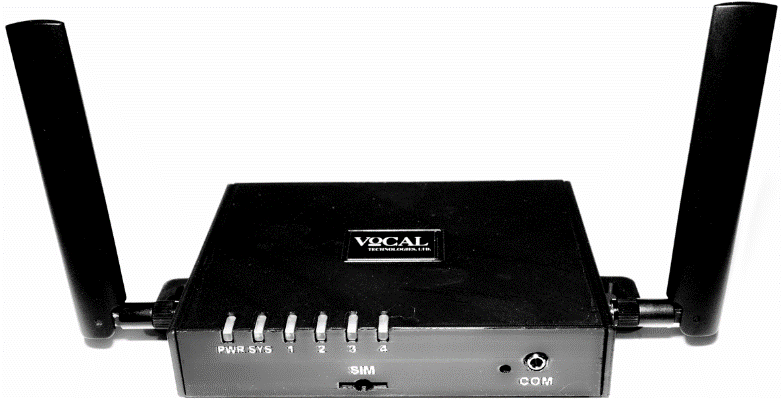
Modem adapters have become increasingly more of a necessity in recent times. FCC order 19-72A1 declared that all POTS lines must be replaced by alternative services by August 2, 2022. Needless to say, many POTS lines are still in use with cost increasing yearly as a motivation to implement alternate communications. Solutions for all easy to upgrade POTS installations are already commonly deployed. However, there are still many highly critical installations that are beyond the capability of these solutions. Modem adapters like VOCAL’s AMA and AMX can be used in those niche situations to ensure a painless transition.

What is an Analog Modem Exterminator?
VOCAL’s Analog Modem Exterminator (AMX) is a unique multi-service device that supports several different modes of communications previously deployed over telephone lines. Telephone lines have been used for communications with remote sites for monitoring and control over serial data channels (often using data modems). Telephone voice circuits have also been used for verbal alarm reporting and for remote voice transmission through radio equipment. Systems for alarm monitoring use signaling via DTMF, tonal and low speed modems for remote site monitoring. Custom remote site monitoring systems often have additional circuits for simple controls and support general inputs for observation.
The AMX is a device, like an Analog Telephone Adapter (ATA), that enables a physical voice-band dial-up modem, that would normally connect to a telephone line, to instead connect directly to an IP network. An AMX locally demodulates the modem audio and extracts the data stream. This data stream is sent over a secure TCP/IP connection where it can either be remodulated to communicate with another modem endpoint, or it can be directly consumed by a back-office data processing system.
Modem Adapter Uses
VOCAL’s Analog Modem Adapters (AMA or AMX) are used at remote locations to facilitate a demodulation and re-modulation approach to modem over IP. AMXs communicate over an IP connection to a Remote Analog Modem Server (RAMS) and the RAMS server delivers the data to an application residing on a host computer. Alternatively, a VOCAL SIP Analog Modem Server (SAMS) may be used if modulated modem signals need to be delivered to the monitoring application. The AMX also functions as a standard Analog Telephone Adapter (ATA) to support voice calling over the public telephone network to deliver and manage alarm indications by voice and DTMF tones. These connection scenarios are useful when there is a requirement to remove physical analog lines, the physical modems cannot be replaced, and there is a need to retain basic voice operations.
LTE Connectivity
Both the AMA and AMX support optional LTE connectivity to allow the transport of control and modem data over LTE networks. The LTE option allows the AMA/AMX to be installed in remote locations where Ethernet connectivity is not available. Traditionally, these locations were only serviced by analog POTS lines that could not be removed because there were no other viable options. VOCAL’s AMA/AMX LTE option provides a simple path for migration. By locally terminating the modem communications and extracting the underlying data stream, the AMA/AMX is able to complete the modem call reliably which would be totally impossible over a voice band LTE cellular call.
WiFi Connectivity
WiFi connectivity is available for both the AMA and AMX devices. This option may be useful in some customer installations such as utility yards but care needs to be taken to ensure site security. VOCAL’s AMA/AMX devices connect to WiFi as a client with configurable security options and settings.

Applications supported by AMX
SAMS/RASoIP
A VOCAL proprietary approach to Modem over IP (MoIP) uses VOCAL’s SIP Analog Modem Server (SAMS) and VOCAL’s Remote Access Serial over IP (RASoIP). The SAMS facilitates data/fax/alarm signaling over a SIP network using encoded analog content in G.711 RTP audio streams to/from a remote modem or modem bank used by back-office servers. RASoIP is used to extend the IP network communications from SAMS to the endpoint(s) within an AMA/AMX. This combination implements a modem demod/remod approach similar to V.150 but often simpler and provides for more features (such as signaling for alarms).
VOCAL’s Remote Analog Modem Server (RAMS) application firmware simplifies the prior SAMS/RASoIP by also incorporating the legacy modem bank used by back-office servers. RAMS simulates a modem bank for the Back-office server and communicates with remote modems attached to an AMA/AMX. Each configured AMX port registers with RAMS so that its legacy phone number can be used by the back-office server for direct communications. The legacy phone numbers may be directly used (and do not need to be ported to a SIP carrier). If standard voice communications are also required, the AMX voice may be handled by any VoIP provider using SIP using its ported legacy phone number (or a new number of course).
The VOCAL AMA/AMX with MoIP application firmware uses a standards-based approach to bridge the gap between legacy STE secure phones (or analog vIPer phones) and modern VoIP networks. It implements the MoIP protocol to locally terminate the modulation that carries the secure encrypted voice data. This data is then sent over the SPRT protocol to another MoIP appliance (or gateway) where it can be remodulated and sent to another STE phone. The AMX can be paired with VOCAL’s SPRAG MoIP Gateway for a complete end-to-end solution that is directly compatible with remote secure phones with no changes required on the far end
While there are many claimed T.38 compliant analog telephone adapters, many are inferior and limited in their support. VOCAL’s T.38 FAX application for its AMA/AMX supports T.38 Version 3 which means V.34 fax machines can operate at full speed if used end-to-end. VOCAL V.34 Group 3+ fax software has been used in commercial fax machines and by fax service providers for many years.
Voice support on VOCAL’s AMA/AMX can be incorporated into nearly every VOCAL AMA/AMX application. Voice mode is often used for initial communications between the endpoints prior to the establishment of digital modem sessions. Secure phones will start in voice mode and then transition to a modem connection for transport of encrypted voice. Customers may also have requirements for regular voice access to a POTS terminal sharing the phone line with a modem. The VOCAL SIP application for the AMA/AMX recognizes phone numbers dialed by the voice terminal or modem device and routes calls to a configured SIP phone service or to a SAMS (using RASoIP) or RAMS or SPRAG server for handling of modem calls.
Telemetry/Utility Meters
The AMX application emulates a serial modem for the remote equipment. Industry standard and custom AT modem command sets are supportable by VOCAL. Communications are redirected to a VOCAL SAMS for remote modem signal modulation to the PSTN or to a RAMS for access as a terminal server port.
Alarm Over IP
Alarm panels use multiple communications methods including DTMF, tonal and low speed modems (some use V.32/V.34 modems while most simply use FSK Bell 102 for V.21). VOCAL’s AMX alarm panel application operates with AT command set support for precise tone generators and detectors and automation for SIA transactions.
The AMX application for Point-of-Sale (POS) terminals typically use V.22 modems with a quick connect process (used by Verifone) to send ASYNC or HDLC framed data. VOCAL supports all common non-standard methods for POS applications including byte timing in both the AMA/AMX and SAMS configurations.
Modem Emulation
Utility meters can often be installed in remote locations where Ethernet connectivity is not typically available such as substations, pipelines, or remote outposts. VOCAL’s Utility Application for the AMA/AMX provides a solution for continuity of service when removing analog POTS lines. The AMX allows both polling from the central office and dial backs from the meters and PLCs. The AMX also segments the metering connections away from the public telephone network, increasing security by eliminating adversarial dials into the devices.
Remote Serial Port Access
The AMX application communicates with VOCAL’s RAMS for direct serial port access as a terminal server port.
E&M Voice Access
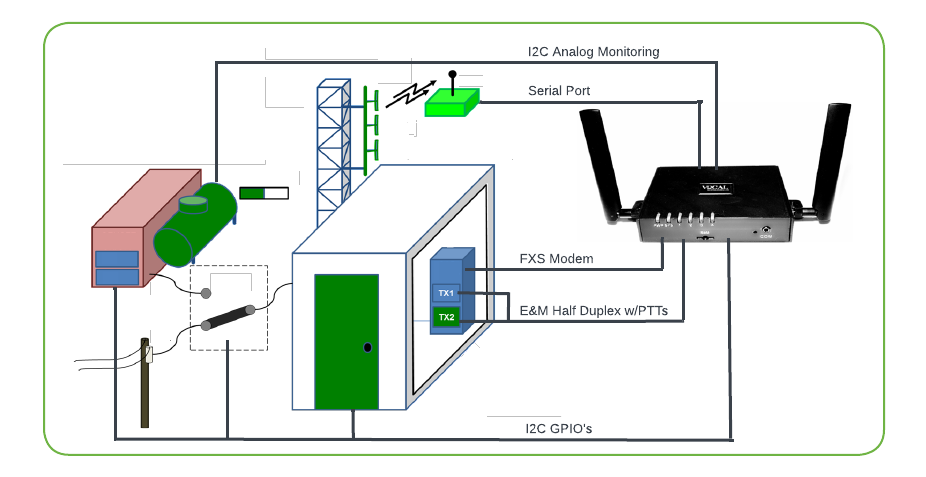
The AMX application uses SIP to operate the E&M audio ports as voice channels. The E&M circuits may be used as a single bi-directional audio port using 4-wire conventions or as two independent full-duplex audio ports using 2-wire conventions. The former is traditional for E&M applications while the latter is suitable for intercom or door communication circuits.
E&M Radio Access
In addition to voice, the AMX also supports radio operations with PTT and COS/COR options. SIP, with optional ED-137C support, is used for establishing voice communications and operating push to talk (PTT). Voice Operated Transmission (VOX) and DTMF are standard configurable methods to activate PTT. Optional methods include use of Selective Calling (either SelCall or SelCal), Continuous Tone-Coded Squelch System (CTCSS) and ED-137C. ED-137C uses RTP header extensions to convey the activation of PTT.
GPIO Control, Monitoring and Alarms
Application specific GPIO signals are available through I2C either externally or internally with the AMX GPIO expansion card. Software for the control of these signals may be developed with VOCAL’s support for use in the AMX for real-time control, monitoring and alarm generation.
Voice alerts utilize application specific GPIO signals monitored by custom AMX software. Voice alerts are generated as outgoing SIP calls to one or more configurable numbers. An incoming SIP call to a designated number could be used for querying present and past alarms/alerts. Simple DTMF may be used for clearing, resetting or configuring monitoring/control conditions.
Use Cases
Utility Meters
- Fuel – Water – Energy – Hydro
- Itron MV-90 xi
- PrimeRead
- Autosol
- Honeywell CONNEXO
- MasterLink
- SIA DC-03: SIA Format (SIA FSK)
- SIA DC-04: SIA 2000
- SIA DC-05: Ademco Contact ID
- Sonitrol
Building Infrastructure
- HVAC
- Energy Management
- Refrigeration
- Industrial Controls
- Building Automation
- Veriphone
- Visa I/II
- SDLC/HDLC
- ISO 8583
- V.22 Fast Connect
Out-of-Band Management
- Managed Network Infrastructure
- Dial-in Remote Access
- Modem Based Fallback Routing
- vIPer Phones
- STE/STU phones
- Secure Data Terminals
AMA/AMX Software
VOCAL’s AMA/AMX software data modulations include V.34, V.90, V.92, V.32/bis, V.22/bis, V.21 and V.23. The software is part of a fully integrated and highly configurable VoIP software solution with a Network Stack, SIP Stack, secure communications, full-featured Telephony software with a comprehensive data modem software library.
VOCAL’s AMA/AMX software is modular and optimized for DSPs and conventional processors from TI, ADI and other leading vendors. Our AMA/AMX software is available for licensing as a library or a complete design with custom solutions available.
VOCAL’s solution is available for the above platforms. Please contact us for specific supported platforms.
More Information