
Secure Communications Interoperability Protocol
The National Security Agency (NSA) developed the Secure Communication Interoperability Protocol (SCIP) as a communications standard enabling interoperable secure communications for the US and its allies. SCIP is a defined by a series of numbered specifications. These specs assure that U.S.DoD, NATO, and other allies can securely communicate. These specification grew from earlier Future Narrowband Digital Terminal (FNBDT) specifications. Secure Terminal Equipment (STE) and vIPer Phones are devices that implement these standards.
SCIP-210 is a Signaling Plan defining application layer signaling for secure end-to-end communication sessions between two devices. SCIP is independent of network transport and supports a a wide variety of transports. The operational mode (e.g., voice, data, etc.), cryptographic algorithm suite (e.g., Suite A, Suite B, etc), and traffic encryption key are negotiated for each session. SCIP provides cryptographic synchronization and operational mode control between devices.
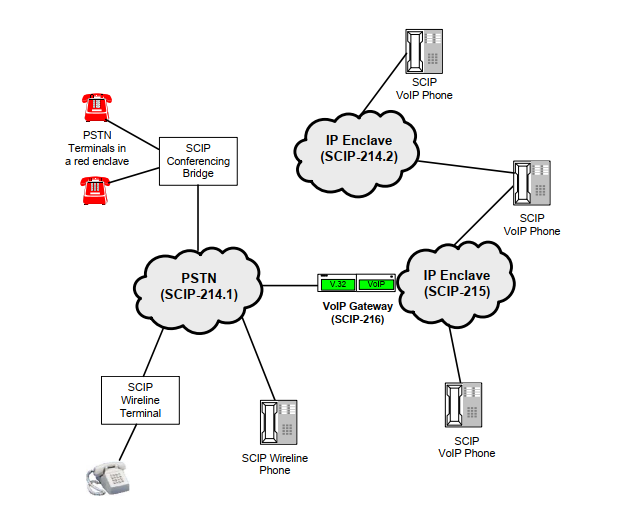
SCIP-214 Network Specific Minimum Essential Requirements (MERs) for SCIP devices – defines operation over specific transports such as PSTN, ISDN, CDMA, GSM, IP, and satellite. A few examples:
- SCIP-214.1 PSTN: This MER specifies how a ITU-T modulations and protocols are used to transport SCIP messages. ITU-T V.32 and V.14 are mandatory, while V.32 bis, and V.34/V.8 are optional.
- SCIP-214.2 RTP: This MER specifies how SCIP messages can be transported via the RTP protocol. State transitions between Audio, SCIP over RTP, Modem relay are described.
- SCIP-214.6 STAC-IS Secure Tactical Communications – Interoperability Specification: The STaC-IS specification addresses the transport of voice and data over tactical radio networks. It specifies how devices; both legacy and nextgen; based on HF and V/UHF RF, carrying Narrowband and Wideband audio, using different waveforms, crypto and error correction are to interoperate. It specifies how combinations of various MIL_STD and STANAG such as MELPe and TSVCIS shall work together.
- SCIP-214.7 ITU-T V-Series Modem Pass-Through with G.711: This MER specifies how a ITU-T Voice Band Data Modem signals carrying SCIP messages are transported over G.711.
SCIP-215 U.S. SCIP over IP Implementation and MER: This MER specifies how a MoIP (Modem Relay) capable SCIP endpoint uses MoIP, a way of trasporting modem data over an IP network to interoperate with Modem based SCIP devices or other MoIP endpoints. Devices which meet this spec can interoperate with VOCAL’s SPRAG Service and related offerings.
SCIP-216 MER for MoIP Gateways: This MER specifies how a MoIP (Modem Relay) gateway, which converts between a voice band data modulation over G.711 and MoIP, a way of carrying demodulated data over an IP network. A SCIP-214.7 endpoint and a SCIP-215 can communicate using a SCIP-216 gateway. VOCAL’s SPRAG Service, and related MoIP offerings meet this specification.
SCIP-233 Cryptography specification and related reference Modules: The sub series, (1xx, 2xx, etc.) are specific areas of secure comms, such as crypto, key material, key processing, traffic type etc. A few examples:
SCIP-233.501 Secure MELP: For Low bit rate secure voice, the MELP vocoder is used. Three rates are used:
- 2400 bps 54-bit frames @ 22.5 ms
- 1200 bps 81-bit frames @ 67.5 ms
- 600 bps 54-bit frames @ 90.0 ms
SCIP-233.502 Secure G.729D: For slightly higher bit rate, but still low enough for transmission over a data modem, the G.729D vocoder is used. Rate:
6400 bps 64-bit frames @ 10.0 ms
VOCAL’s expertise in the design, implementation and configuration of Defense and Aerospace communication systems ranges across a broad spectrum of technologies. Our innovative designs have been incorporated into UAVs, video surveillance, voice and data RF devices, military radios, secure government communications devices, lawful interception systems, and Radio over IP systems in government and military infrastructure.