
V.152 Gateway
Having trouble connecting your Sectéra® vIPer™ phone to VoIP?
Try VOCAL’s Cloud-hosted Secure Phone Service here.
VOCAL’s V.152 Gateway on software is a standards based implementation that incorporates transport of analog modulated signals generated by data modems, facsimile terminals, and PSTN text telephone across IP network as audio compressed with a suitable codec, such as G.711. This solution supports modem over IP (MoIP), fax over IP (FoIP), text over IP (ToIP) operation in Voice Band Data (VBD) mode. The fast-paced migration to IP-based communications has generated a need for transmitting voice-band data, such as fax, data modem and text telephone signals over the IP network. This can be accomplished through the use of VOCAL VBD gateway to interface between the PSTN and IP networks. The gateway demodulates the incoming data and transmits the pertinent information over the IP network to the remote gateway so that it may be modulated and sent to the remote machine.
Features:
Payload Type Indication – This default method for switching between transport modes using RTP payload types are supported in the gateways.
SSE – Signaling State Events are Supported, it is a mechanism by which the media states are synchronized between the media gateways.
SPRT – Simple Packet Relay Transport for text relay is supported along with different data types (I_OCTET, I_OCTET_CS, I_RAW_OCTET) to carry the data from one gateway to another.
SDP – Different variations of the Session description based on the requirement available, e.g., port sharing where you can send the SPRT and the RTP over the same port.
Interoperability – Our gateways use a number of modulations and character encodings with many other different vendors.
Scalability – A large number of channels on a single gateway can be supported, starting from 10s to 100s based on the gateway.
Flexibility – VOCAL’s V.152 gateway is based on a hardware independent library, allowing for a large number of the target platforms. Any standard Linux or Windows distribution is supported, along with a wide variety of embedded platforms.
Benefits:
- 100% software solution easily migrates to the cloud
- High speed fax modulation – V.34
- Low speed fax modulations – V.17, V.29, V.27ter, V.21
- Supports standard protocols such as t.30, t.4, t.6
- High speed data modulation – V.34, V.90, V.92 (optional)
- Low speed data modulation – V.32, V.32bis, V.22, V.22bis, V.23, V.21
- Supports standard compression protocols such as V.42bis and MNP5
- Supported modulations in text relay mode include V.23, V.21, Bell 103 standards
- Eliminate extra trunking because of convergence of data, voice, and fax.
- Interconnection of multiple communications networks, such as wireless, wired PSTN, and IP networks, is an important capability for the defense system.
- Telemetry application transport over IP-based networks can give reliable economic solutions.
VOCAL’s V.152 implementation can be combined with other VOCAL XoIP series of recommendations like Modem-over-IP (MoIP) or Text over IP (ToIP). Although for each XoIP recommendation, there is a requirement that the support for it has to negotiated with the remote gateway specifically.
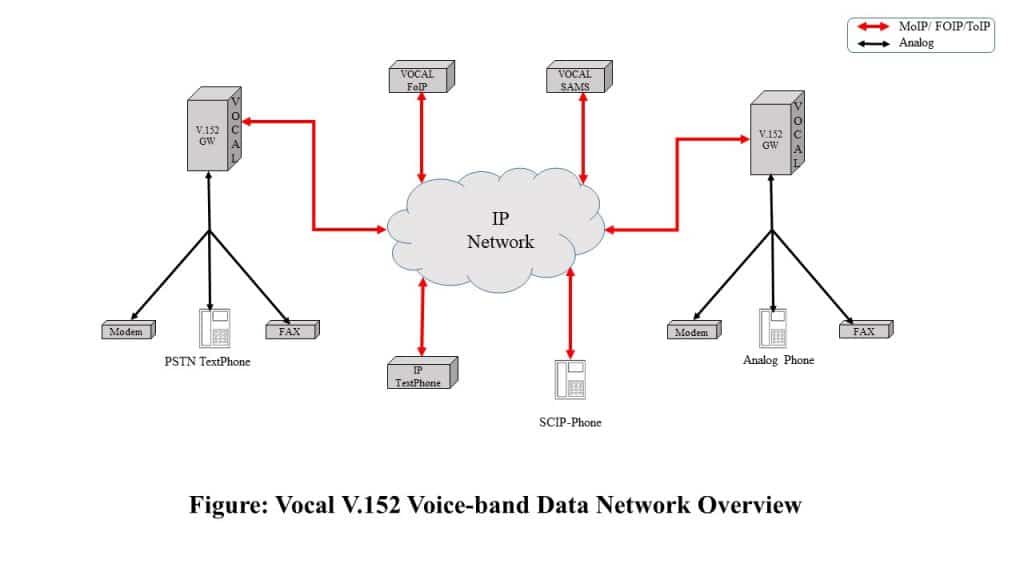
Flexible Implementation:
- Based on decades of experience engineering modems and VoIP telecommunication systems, VOCAL is uniquely capable of creating modem systems that run purely in software, or on your custom hardware system, and interfacing with your customized interfaces and specialized applications. Whether your modems are on one or both ends of the network, VOCAL has a safe and reliable solution.
- VOCAL’s systems are ITU-T and IETF standards based and fully compatible, so replacing an existing MoIP gateway will happen seamlessly. Variations include communication with both gateways or standalone endpoints that send MoIP messages directly on the IP link.
- VOCAL’s MoIP implementation adheres to the Secure Communication Interoperability Protocol (SCIP-215, SCIP-216 Rev 2.2). Our End-Terminal software uses MoIP directly, to communicates with a modem located on the PSTN via a MoIP gateway.