Common vIPer™ Phone Challenges
Sectéra® vIPer™ phone and other secure phone customers often have issues operating from their on-premises secure location with their local telephone switches and/or their organization’s designated telecom provider. The SIP-based local telephone switches and/or telecom providers typically do not understand MoIP and related aspects in SDP negotiations. Hence end-to-end calls are relegated to use of G.711 communications of modem signals which is often un-reliable unless the organization has a premium connection to a telephone service provider connected to the nation’s telecom backbone.
Other common challenges faced by secure phone customers are operation over a) potentially lossy packet networks, b) networks with unusual media restrictions or firewalls, c) satellite networks and d) networks with poor sample timing synchronization. Data modem and fax machine operations typically do not work well in most VoIP environments unless special handling is provided. In some installations, a telecom provider offers a G.711 service which usually works well for fax operations. In most installations, however, fax must be handled by a T.38 capable Analog Telephone Adapter (ATA). VOCAL supports data (and fax) modem operations with its Analog Modem Adapter (AMA) which may be useful for some vIPer™ phone and other secure communications installations.
VOCAL SPRAG Solution
VOCAL’s SPRAG solves these challenges (and others) by being located in the cloud (using Amazon Web Services) with an MPLS quality peering connection to a major domestic telecom carrier. Connection with the carrier is a) co-located service in the same data center, b) high reliability, low latency connection (often a SDN with a dedicated VPN) and c) monitored high quality of service (QOS). All the major domestic carriers (AT&T, Verizon, CenturyLink, Level3 and Inteliquent) are well interconnected themselves. G.711 modem calls work well on these networks as VOCAL has demonstrated for years with its SAMS (SIP Analog Modem Server) and FoIP/T.38 gateways it has offered to other customers. Timing synchronization is essentially guaranteed with optimal network connections to a telecom carrier.
SPRAG works with secure phone devices as a secure voice gateway to these public telecom carriers. MoIP protocols are used in secure mode with the vIPer™ phone over the potentially lossy/poorly timed network connections from the secure customer to VOCAL’s SPRAG server. SPRAG is capable of dynamic transitioning between audio passthrough, VBD, and MR modes making it ideal for secure voice applications requiring just in time transitioning between clear channel audio and secure voice modes. Once at VOCAL’s server, the G.711 modulated signals are exchanged with the other endpoint without loss (assuming the other endpoint has its own robust high-quality G.711 connection).
Private SPRAG Platform
The Private SPRAG is available in VOCAL-provided leased hardware as a 1U rack mount chassis in three configurations. Typical installations use SuperMicro or Dell platforms with Intel Xeon 6 SoC processors with varying number of cores/threads ranging from 8 to 20 cores. The largest configuration uses 20 cores to support up to 240 simultaneous secure calls. Optional SFP connections provide up to 100G Ethernet (other Ethernet speeds available on alternate platforms). Additional spans support partial link redundancy in case of link failure. Redundant power supplies are available for many of these platforms.

Shown: Supermicro® based platform. Customer preferred platforms may be considered for the Private SPRAG system.
Note: Customer provided dedicated platforms or cloud servers would use VOCAL’s Licensed SPRAG Gateway offering with identical features and similar call handling capability.
VOCAL’s well deployed SPRAG MoIP service for vIPer phones is used on this platform in an embedded environment. All conversions from/to SIP/MoIP protocols, as used by vIPer phones (or similar MUOS equipment), to/from G.711 modem V.32/V.34 modulated signals are handled internally in-the-box. The customer must have a reliable no-loss network connection to its phone service preferable at the same location as the Private SPRAG server.
Interoperability Testing
VOCAL’s SIP-based MoIP Media Gateway software (the core of its commercial SPRAG service) has been JITC tested in a router subsystem that is being deployed by the US Navy. VOCAL’s SIP/MoIP software has been tested successfully with Avaya, Cisco Unified Communications Manager(CUCM/CallManager), NEC, Nortel, Redcom and Ribbon MoIP switches/SBC’s (most today only support MoIP protocol pass-through and not media conversion to legacy modem signals). And while we are compatible with older SIP/MoIP media gateways, most have largely been discontinued as they relied on a Freescale Starcore processor implementing protocol conversion between MoIP and modem modulations for V.32 and/or V.34. Freescale, Agree and Infineon end of life-ed its products using Starcore components due to company closure of Starcore LLC in 2006 by NXP (acquired through its acquisition of Freescale and its products) and ceasing all production by approximately 2023. VOCAL’s SIP/MoIP software is implemented on general purpose Intel/AMD x86 (or ARM) processors running either Windows or Linux. As such obsolescence is not dictated by platform retirement with newer x86 (or ARM) processors and platforms constantly being offered commercially.
Typical Private Server Installation
The VOCAL Private SPRAG may be used in a variety of potentially lossy or unusual network topologies to facilitate secure communications between SIP/MoIP devices with other vIPer phones located anywhere in the world. Using a fictitious Moon LTE-based Satellite Relay Network (MLSRN) as an example network, the Private SPRAG is used for interconnection to the world’s PSTN (Public Switched Telephone Network) accessed over a public IP network. This of course could connect to any other phone network such as the government DISN (Defense Information System Network) or DRSN (Defense Red Switch Network). Note, firewalls and routers are not shown but absolutely required for a secure system.
The vIPer™ Radio/Phone terminals use SIP/MoIP protocols to register with the Private SPRAG and to place and receive secure calls. An outgoing call from a vIPer™ Radio terminal includes the telephone number of a destination terminal on the PSTN (or DISN/DRSN). Call signaling is conveyed by SIP through the Private SPRAG and passed connected IP phone network. Similarly, incoming calls from PSTN (or DISN/DRSN) are received and passed as SIP signaling to secure terminals on the MLSRN network.
.
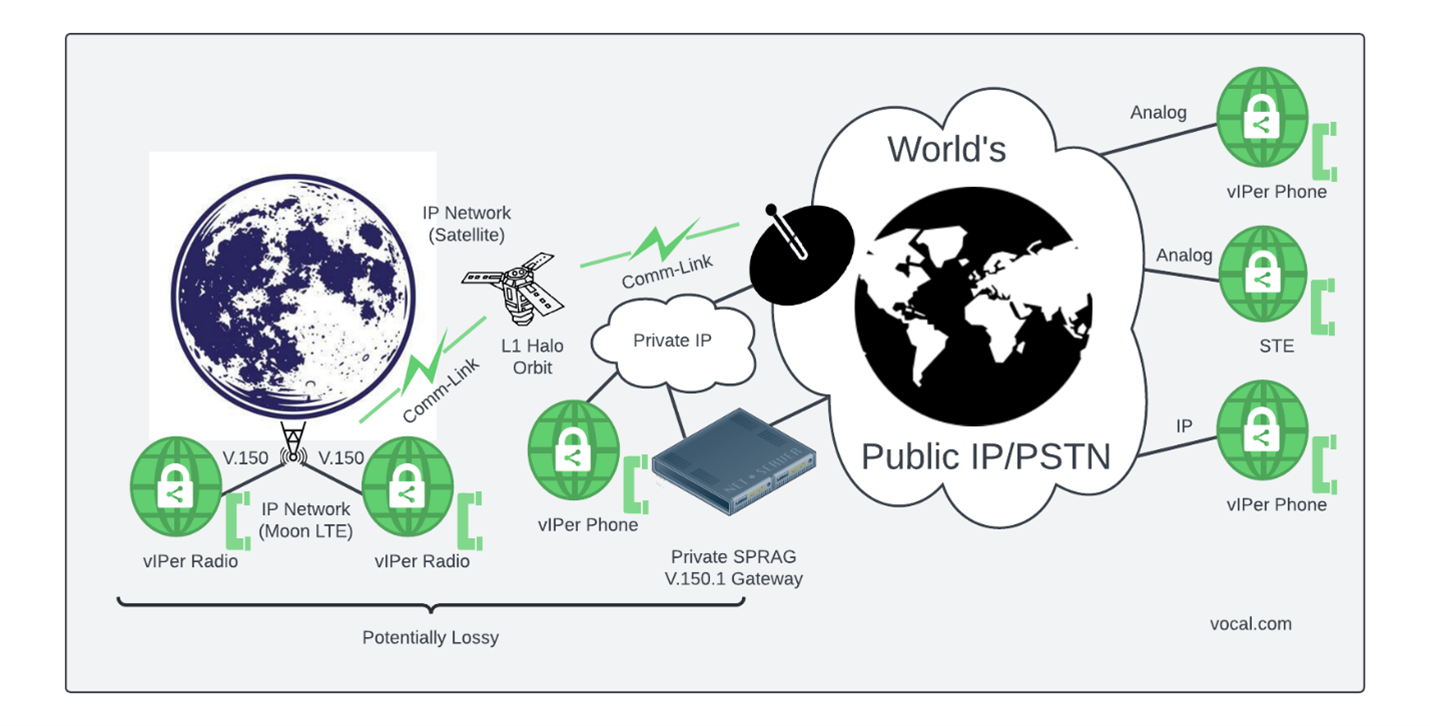
Configuration of VOCAL’s Private SPRAG is substantially simpler than many other “general purpose SBC/gateway devices”. The role of this VOCAL device is to function as this bridge between SIP/MoIP and conventional SIP/RTP/G.711 telephone domains. Registration of each vIPer Radio terminal is optional (and unnecessary) if the Private SPRAG is to function as a trunking service between a SIP switch in the MLSRN network (not shown) and the external SIP PSTN network. Call routing tables for the selection of multiple distinct PSTN networks may be provided. Alternatively, separate isolated VOCAL SPRAG services may be run in the private platform using different UDP/TCP ports for SIP call control signaling to access their respective DISN/DRSN networks. Or for greater redundancy/security, two separate physical Private SPRAG servers may be used for connection to each network.

Supported Devices
- Sectéra® vIPer™ Universal Secure Phone
- Sectéra® Wireline Terminal
- IP STE Phone (or STE with VOCAL AMA/AMX)
- MUOS SCIP MoIP Terminal
- Other MoIP capable secure phones
- Non-MoIP capable secure devices can be supported using VOCAL’s AMA/AMX devices
- Other Non-MoIP modem devices using VOCAL’s AMA/AMX devices
- Misc. Voice Band Data Modem devices using VOCAL’s AMA/AMX devices
Sectéra®, TalkSECURE™, and vIPer™ are trademarks of General Dynamics.